T H E F I L M S T U D I E S W E B S I T E O F B E N T O N P A R K S C H O O L
What is Narrative Structure?
Narrative structure is really about two things: the content of a story (i.e. what a story is about)
and the form used to tell a story (i.e. how a story is told).
Two common ways to describe these
two parts of narrative structure are: story and plot.
Story refers to the raw materials of dramatic action as they might be described in chronological
order in a film.
Plot refers to the form of storytelling, or the structure, the story follows.
An example may be helpful.
If we want to analyze narrative structure, we can use who, what, and where questions to
look at the story or content of a movie.
How questions are used to examine plot structure.
Let’s begin with some definitions.
The definitions are below and further excellent analysis is available HERE
Deconstruction
Separating Plot And Story
Think of a feature film, and jot down
a) the strict chronological order in which events occur
b) the order in which each of the main characters finds out about these events
a) shows story,
b) shows plot construction.
Plot keeps audiences interested eg) in whether the children will discover Mrs Doubtfire is really their father, or shocks them, eg) the 'twist in the tale" at the end of “The Sixth Sense”.
Identifying the Narrator who is telling this story is a vital question to be asked when analysing any media text.
Stories may be related in the first or third person, POVs may change, but the narrator will always
* reveal the events which make up the story
* mediate those events for the audience
* evaluate those events for the audience
The narrator also tends to POSITION the audience into a particular relationship with the characters on the screen.
Comprehending Time
Very few screen stories take place in real time.
Whole lives can be dealt with in the 90 minutes of a feature film, an 8 month siege be encompassed within a 60 minute TV documentary.
There are many conventions to denote time passing, from the time/date information
typed up on each new scene of The X-
Other devices to manipulate time include:
* flashbacks
* dream sequences
* repetition
* different characters' POV
* flash forwards
* real time interludes
* pre-
Locating the Narrative
Each story has a location.
This may be physical and geographical (eg a war zone) or it may be mythic (eg the Wild West).
Virtual locations are now a feature of many newsrooms (eg the computers and holograms of the BBC's Nine O'Clock News).
There are sets of conventions to do with that location, often associated with genre and form (eg all space ships seem to look the same inside).
Narrative Conventions
When unpacking a narrative in order to find its meaning, there are a series of codes and conventions that need to be considered. When we look at a narrative we examine the conventions of
* Genre
* Character
* Form
* Time
and use knowledge of these conventions to help us interpret the text.
In particular, Time is something that we understand as a convention -
Therefore we consider "the time of the thing told and the time of the telling." (Christian Metz Notes Towards A Phenomenology of Narrative).
It is only because we are used to reading narratives from a very early age, and are able to compare texts with others that we understand these conventions.
A narrative in its most basic sense is a series of events, but in order to construct meaning from the narrative those events must be linked somehow.

Excellent methods to help you deconstruct narrative from this excellent website


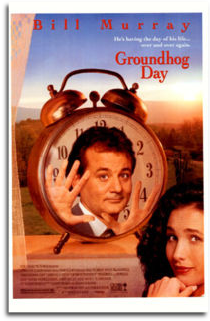
Here’s a review from Phillip French, one of the world’s greatest film critics. He writes in The Observer every Sunday
Groundhog Day
Philip French
Sunday August 13, 2006
The Observer
Directed by Harold Ramis
1993, PG, Sony/Columbia
Now that we've had such inventive metaphysical Hollywood comedies as Being John Malkovich,
Adaptation and Eternal Sunshine of the Spotless Mind, this movie seems less extraordinary
today than it did a dozen years ago. In 1993, this subtle, thoughtful film came out
of the blue from a director, Harold Ramis, and a star, Bill Murray, principally associated
with broad, crowd-
Murray, who combines the poised dead-
If there's no tomorrow, anything is possible and Phil can try anything, including suicide, can be an indulgent child, a Superman, the local Mr Nice Guy or God himself. And he can perfect his character and effect a moral transformation.
The idea is not new.
Several sci-
But the script by Ramis and Danny Rubin is endlessly inventive, and Ramis handles the movie with a lighter touch than he has shown before or since. It's one of those films that rewards regular visits and in which you see different things according to your age and your mood.
It's difficult, for instance, to see the repeated encounters between Murray and the
insurance agent played by the marvellous Stephen Tobolowsky without thinking of the
latter's tragic entrapment in a later film about time and memory, Christopher Nolan's
Memento. There's a first-
A time loop is a common plot device in science fiction (especially in universes where time travel is commonplace) in which time runs normally for a set period (usually a day or a few hours) but then skips back like a broken record.
When the time loop "resets", the memories of most characters are reset (i.e. they forget all that happened). This situation resembles the mythological punishment of Sisyphus, condemned to repeatedly push a stone uphill only to have it roll back down once he reached the top, and Prometheus, condemned to have his liver torn out and eaten by an eagle each morning.
The plot is advanced, however, by having one or more central characters retain their memory or become aware of the loop through déjà vu.
The best-
Stories with time loops commonly center on correcting past mistakes or on getting a character to recognize some key truth; escape from the loop may then follow (this can be seen as a metaphor for reincarnation).

Third reality
The story starts a third time. Lola is a split second faster, since she leaps
over the steps where she would be tripped, and stops on Mr. Meyer's (her father's
co-
This allows Mr. Meyer to get to work and pick up Lola's father. As a result, Lola misses her father completely. Not knowing what to do, she decides to simply keep running.
She arrives at a casino, receives a single 100-
She hitches a ride in the same ambulance from before, unnoticed by the driver, as it stops in front of the crew with the window pane.
The ambulance is carrying Schuster, the security guard from her father's bank, who has apparently suffered a heart attack, as foreshadowed by his clutching his chest and his loud heartbeats on the soundtrack earlier in the film.
Although some English subtitles have Lola saying "I'll stay with him," the actual German line is "Ich gehöre zu ihm," which translates as "I'm with him" (literally: "I belong with him.") She holds Schuster's hand, and moments later, his heart rate begins to return to normal.
Meanwhile, Manni has borrowed a phone card from a blind woman to make a phone call seeking a loan. As in the other sequences, he returns the phone card to the woman he borrowed it from, but this time the woman gestures with her head, and Manni looks up to notice the bum with his money riding by on a bicycle.
Manni is successful in chasing down the bum, recovering his money, and delivering it to Ronnie. He gives the bum his pistol in exchange for the bag of cash, perhaps suggesting that he is going to quit his life of crime.
Lola arrives to find Manni stepping out of Ronnie's car under congenial circumstances. The movie ends with Manni asking Lola what's in the bag she's carrying, which contains her casino winnings.
Throughout the film, Lola bumps into people, talks to them, or passes them by entirely.
Details of that person's future are subsequently shown in a series of still frames.
The futures are widely divergent from encounter to encounter. In one scenario, a woman whom Lola accidentally bumps into wins the lottery and becomes rich; in a different scenario, she remains poor and kidnaps an unattended baby after her child was taken away by social workers.
In yet another scenario, the woman experiences none of the above and becomes a religious preacher.
Several moments in the film allude to a supernatural awareness of the characters. For example, in the first reality, a nervous Lola is shown by Manni how to use a gun by removing the safety, whereas she does this as if remembered from a previous experience in the second reality.
Lola's encounters with Schuster also contain an air of the supernatural, with strong
hints that the two share a father-
The movie itself begins by posing questions pertaining to the unpredictability of the world and the unknowable nature of its meaning.
It suggests that drastically disparate consequences can alter the fates of different people from a one second change in the time of one person's running.
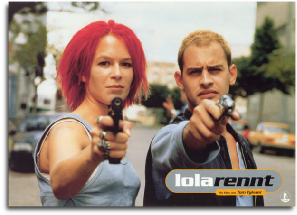
We saw Run Lola Run together so we know the first two episodes; here is wikipedia’s reading of the third



There is a single diegesis–-
The chain of events should follow a logical sequence, and have an inner logic.
The chain of events should be governed by the actions of central characters
The audience should empathize with central characters (drawn in by close-
The focus is on individuals rather than on the societal or collective level
There is a pattern of enigma and resolution, where all questions established during the narrative are answered
Narratives are dominated by verisimilitude -
The technical and symbolic elements in media texts are subordinated to the construction of the narrative and the need to drive it along.

• A state of equilibrium and plenitude exists
• This is challenged by the arrival of an opposing force
• This creates a situation of disruption and disequilibrium
• A unifying and equalizing force arises
• A quest takes place
• The opposing and equalizing force meet
• Disequilibrium continues as battle is joined
• A new equilibrium and state of plenitude is achieved following the victory of the equalizing force.
Except when they don’t, of course........
Try to keep your face straight

Ivan M Tordorov
never a chap to complicate matters when they could be kept simple;he was never quite reconciled to the fact that the ancient greek Zeno had hit on the form of begining, middle and end before him.
I always think he has the look of me dad
God rest him
The structuralist work of Levi-
Levi-
Crucially, myths were used to symbolically understand the contradictory elements of the real world.
Myths provide explanations that resolve the incongruities between man's existence and the natural world. Thus, myths could explain the existence of drought by the eternal battle of good and evil.
Examples of binary oppositions found in some moving image narratives might be:
good vs evil
male vs female
humanity vs technology
nature vs industrialization
East vs West
dark vs light
dirt vs cleanliness

Claude Levi-
a fierce man for the auld anthropology,
never went to Ireland,afraid ,some said, that the natives would tell him a pack of lies or worse, tell him what he wanted to hear.
Characters are central components of all narratives. Vladimir Propp's (1975) formalist work on Russian fairytales, first published in 1928, isolated structures common to all fairytales.
Crucially, he demonstrated the relationship between characters and the structure of the narrative. Fairytales are useful to analyse because they contain stock characters and structural ingredients. After studying 115 fairytales, Propp was able to identify seven main character 'roles', as he called them:
1 the villain
2 the donor (or provider)
3 the helper
4 the princess (or sought-
5 the dispatcher
6 the hero
7 the false hero.
These roles represent the building blocks of narratives, it is their actions, in
what Propp calls 'functions', that construct the narrative Propp states that several
roles may well be filled by the same character and that some may also be filled by
more than one character The most often-
this is because Star Wars makes an interesting point of comparison between the tradition of the fairytale structure and the classic Hollywood moving image product:
1 the villain = Darth Vader
2 the donor -
3 the helper = Han Solo
4 the princess = Princess Leia
5 the dispatcher = R2-
6 the hero = Luke Skywalker
7 the false hero = Darth Vader
The student who expains to Mrs Symons why the above doubtful breakdown is of any value or how it helps will get the Sixth form cast off anorak and a rash of pimples and be invited to apply Propp to “Location Location”


Vladimir Propp.
As an old man Papa Propp, as his students called him, loved to tell this tale:
"once upon a time a young man built a boat with which he would sail away to a kind and a just and a wonderful land
and the boat sank"
As a young man he told happier stories even one which ended (closure to you) with the sublimely optimistic:
"and they all lived happily ever after"
Now Dudes, you are familiar with Chief examiner Phillips stuff on story; it's one of your set texts so don't sit there open mouthed giving it "Que" 'c'os none of us is from Barcelona or other intellectually challenged areas like Kerry or Idaho,or Cleckheaton.
What follows are some of Phillips' gems which I will be incorporating into a test.
Unrestricted narration is when we see everything, including much more than the characters
themselves We hold an advantage -
Restricted narration is when we only have partial access to what is going on (It may also mean that we share the character's false information ) The flashback is a particularly interesting and fairly commonly used tool of film narration Not only does this reorder the chronology of the story, but it also exploits restricted narrative to control the audience access to information.
"Silence of the Lambs" begins with restricted narration; we know only what Starling knows, later we, the audience, learn things that Starling does not know as the narrative becomes unrestricted. This creates a tension between what we know and what she does not. I believe it was my granny who coined the exact nature of the tension:
Jaysus Clarice would you be careful that pervert's got a gun behind him on the cooker and is softening up a woman below in the well, shoot him down like a dog, blow his head off, go on. quick Clarice!!!
Phillips summarises film narrative thus;
it is time based.
occurs in space(location)
empathises causality
• creates interest in its protagonists (characters), who will nearly always be the principle causal agents,
• has a narrative structure a beginning, a middle and an end (although not necessarily conforming to the chronology of the story),
• depends upon the audience to make meaning by fleshing out the plot into story,
• uses narration in order to hold back or manage knowledge and emotion in ways that create active audience involvement in what will happen and why.
• conforms to the requirements of producers and audiences, for example, in regard to running time,
• works within the conventions of a genre form, determining limits to originality, but providing recognition for the audience.
The next bit is top stuff because Phillips addresses the notion of narrative and pleasure; you might get the notion reading some theorists that movies were about pain such as applying Propp or Tordorof (hey why not both!) to the structure of "Run Lola Run"
N A R R A T I V E S U M M A R Y
• Real life seems shapeless One of the pleasures of story is an artistic one, a 'shaping' of messy human experience into something neater This shaping is an aesthetic pleasure and an intellectual one
Out of this shaping come two further pleasures, pleasures which actually pull in
contrary directions. There is the desire in the audience to want more -
• Real life is not often very intense or exciting. A second pleasure of story is to simulate (or perhaps I mean stimulate) a more 'dramatic' existence.
We are offered the opportunity to try out experiences and undergo states of feeling that are often extraordinary in relation to our daily lives These are forms of sophisticated imaginative 'play' in which we willingly participate. We buy into (pleasurable) anxiety'
• As real life is most of the time fairly shapeless (beyond perhaps a sense of a
daily routine) and unremarkable, and, because we are caught up inside it, we are
unable to find clear points of focus for reflection about that life. A third pleasure
of story is that it focuses issues and gives us the opportunity to generalise from
its particular details. We recognise within a particular story the dramatisation
of broader issues, values and states of being. We may simultaneously see the general
nature of these -
A fine poem here; ironic certainly, but the guy knows the difference between the tale life tells and the tale genre allows
War Movie Veteran
You can't tell me a thing that I don't know About combat, son. I reckon I've seen
them all On the big screen or TV, the late-
Or Sunday matinee. I'm what you'd call
An old campaigner; some of them I've seen Four-
Can tell for sure which ones among that green
Platoon of rookies are the guys to die.
You know the sensitive and quiet kid
Who can't stand rough stuff, says his prayers at night
And never cusses? He's got to wind up dead
But not before we've seen that he can fight
And he's got guts. He ain't afraid to kill
Once the chips are down. The one to see
Turn really yellow is the loud-
That talks like he ain't scared of nothing; he
Will go, expendable. So will the other,
The black guy who's as good as you or me,
And the Jew that's seeking vengeance for his brother.
The comedian -
Come through the battle in one piece or not:
He's only there for laughs, that's understood
By veterans like me. The hero's got
To be alive and kicking at the end.
The one I really like -
The tough top-
His favourite meal is bullets, blood and rye;
The Krauts he's killed is anybody's guess.
He's made of steel and leather, but you'll find
That he can be the soul of gentleness
With scared old ladies, babies and the blind
Pooch whose master's been knocked off.
But never Think the guy's gone soft: back under fire
He's just as cold and murderous as ever,
He's everything a General could desire.
He'll come through safe okay.
I tell you, son, I could write out the list of casualties
Long before the battle has begun.
I've seen it all. I know the way it is
And got to be. Well, that's what you could call
The human side, psychology I guess.
The other stuff -
In half-
It takes no time to get the different ranks:
Enlisted men and noncoms, officers,
The names of hardware, ammunition, tanks
And how the thing is planned. You'll think at first
That war is chaos, howl of bullet, shell
And bomb; flashes and thunder as they burst,
Flying shit, hot jig-
Not so. It's all worked out before the start.
It's choreographed, like in a dance, okay?
You get to know the pattern. War's an art,
It's one I understand. There ain't no way
That you'll find anyone to tell you more
Than me about realities of war.
Vernon Scannel

Vernon Scannell
excellent chap
find his poems read them NOW
Soonest


| Silence of the Lambs |
| pleasantville |
| Mississippi Burning |
| Valley of Elah |
| Elephant Gus Sant |
| Narrative |
| FM4 Experimental Film |
| "Talk to Her" |