T H E F I L M S T U D I E S W E B S I T E O F B E N T O N P A R K S C H O O L


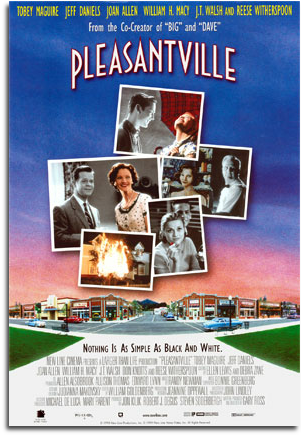
Pleasantville Cast and Crew:
Tobey Maguire -
Jeff Daniels -
Joan Allen -
William H. Macy -
J.T. Walsh -
Reese Witherspoon -
Don Knotts -
Paul Walker -
Marley Shelton -
Jane Kaczmarek -
Giuseppe Andrews -
Jenny Lewis -
Marissa Ribisi
Production Credits:
Dianne I. Wager (Art Director)
Debra Zane (Casting)
Ellen Lewis (Casting)
John Lindley (Cinematographer)
Allison Thomas (Co-
Andy Borowitz (Co-
Edward Lynn (Co-
Allen Alsobrook (Co-
Susan Borowitz (Co-
Randy Newman (Composer (Music Score))
Judianna Makovsky (Costume Designer)
Gary Ross (Director)
William C. Goldenberg (Editor)
Michael De Luca (Executive Producer)
Mary Parent (Executive Producer)
Jon Kilik (Producer)
Robert J. Degus (Producer)
Steven Soderbergh (Producer)
Gary Ross (Producer)
Jeannine Oppewall (Production Designer)
Gary Ross (Screenwriter)
Robert Anderson, Jr. (Sound/Sound Designer)
Chris Watts (Special Effects Supervisor)
Other Films in this Genre:
1998 The Truman Show
1992 Stay Tuned
1990 Mr. Destiny
1990 Back to the Future Part III
1989 Andy Colby's Incredibly Awesome Adventure
1989 The Icicle Thief
1989 Chances Are
1989 Back to the Future Part II
1988 Hairspray
1987 Amazon Women on the Moon
1986 Peggy Sue Got Married
1985 The Purple Rose of Cairo
1985 Back to the Future

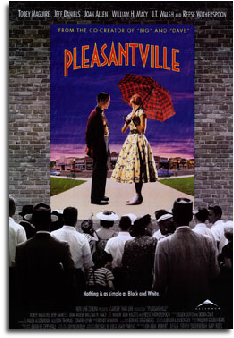

Courtesy of Wikipedia.
A visit to wikip2dia will immediately convince any Film Studies student of its immense value as a rich source of data and insights/
Link to the left
Budget ~ US$40,000,000
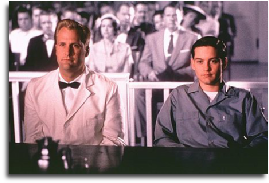
Pleasantville is a New Line Cinema film first released in Canada on September 17, 1998 starring Tobey Maguire, Reese Witherspoon, William H. Macy, Joan Allen, and Jeff Daniels. Don Knotts, Jane Kaczmarek and J. T. Walsh are also featured. In the film two modern teenagers are mysteriously transported into the fictitious community of Pleasantville, the setting of a black and white 1950's television show.
Through their actions the people of Pleasantville begin to experience strong emotion and consequently, events in town begin to deviate from the accepted norm.
The film was written, produced, and directed by Gary Ross, who also performed those duties for the more recent film Seabiscuit (2003), which also starred Maguire and Macy. This was J.T. Walsh's last film, released after his death. The film was released in the United States on October 23, 1998.
Themes
Pleasantville contains several themes including historical references, political contexts, and perceived reality vs. false reality.
The use of color in the film is of prime importance, as it represents the series of changes occurring the town visually. The literally monochrome world of Pleasantville blossoms into a rainbow of colors. Color is introduced slowly and often subtly: at first it may only touch a single flower, or the tongue of a girl.
Color changes are always brought on by the events of the film, particularly epiphanies experienced by the characters.
Historical references
The change in color is the primary visual effect used to accent the changes to the people and the world they inhabit, changes which challenge the values and emphasis on continuity and conformity that many consider to be the hallmark of 1950s America.
Much of the film's satirical tone is captured in the "Code of Public Conduct" which the Pleasantville citizens establish, trying to protect themselves from upsetting changes.
One rule forbids music other than "Johnny Mathis, Perry Como, Jack Jones, the marches of John Philip Sousa, [and] the 'Star Spangled Banner'".
Another rule echoes the Scopes Trial by requiring all schools to teach the "non-
Pleasantville also contains color-
Also alluded to is the temporary end of the Renaissance in Florence Italy near the
end of the 15th Century where Mr. Johnson, the lead soda jerk turned Avant-
Mirroring the famous Renaissance artist Sandro Botticelli, Mr. Johnson is willing to abandon his artistic standards in order to conform to the public's viewpoint. Although the reactionary elements triumph, it's only temporary as change and progress is inevitable. It isn't long before most citizens embrace the new culture.
When the townspeople were throwing the books into the fire, it is similar to the imfamous "Burning of the books" in Nazi Germany in the 1930's (e.g. burning of "undesirable" books).
Biblical allusions
It becomes apparent that most of the characters in the film have biblical equivalents and several key religious images emerge throughout the film.
David and Jennifer represent Adam and Eve and are thrown into the Garden of Eden
(Pleasantville) by a Godlike character (the TV repairman). This Judeo-
One explicit allusion to the Bible is the first image of the book "The World of Art": "La cacciata dal Paradiso" of Masaccio (see: Cappella Brancacci).
The burning tree (the burning bush) caused by Betty's first sexual experience is often cited as an example of biblical parallelism within the film, but producer Gary Ross stated on the DVD's audio commentary track that this allusion was unintentional.



Paddy’s take on the use of colour in Pleasantville.
The fist object in the film that changes from black and white to full technicolour
is a rose that Skip notices in the hedge. The rose is a very obvious symbol and
its complex symbolic history goes back at least as far as the Middle Ages. The director’s
intention is to be very self-
The question we have to ask is, who is responsible for objects in the film, changing colour,or migrating from colour to black and white? At first it seems to be all about awakening sexuality, the girl blowing a beautiful pink bubble with her bubblegum is perhaps aware of what she is doing sexually. The gum may also have changed colour, because the boy she is blowing the bubble for is conscious of how sexual the act is.
Why is the car outside the diner, a vivid green? Is it because the car itself is intrinsically sexual or because it is perceived as sexual by those who look at it.
The colour clock inside the diner is in colour, because time, for the adolescent, especially, is a highly charged emotional phenomenon, or because time itself represented by the clock is of itself highly charged matter?
Certainly, it becomes clear very rapidly that moving into colour is not exclusively about sexuality or sexual awakening. Books, it seems, are also capable of making the change from black and white to colour.
Just how we choose to interpret the symbolism is obviously a subjective matter.
In a film which has been relentlessly black and white for at least 30 minutes the arrival of colour brings its own excitement and delight and is clearly to be preferred over the rest of the largely black and white Pleasantville.
When the film moves into the area of segregation, where people of colour are set against people who are normal and black and white, the film, then tends to get itself lost, and, I suspect, for black Americans, particularly black Americans from the deep south of America, the film could be deeply insulting.
It was not white people who faced a colour bar and segregation in every aspect of the daily lives. It was white people, who implemented this segregation.
There are no Negroes in Pleasantville.
While the film fails, it is an ambitious failure, and it certainly successfully holds up to scorn and ridicule the nay saying, small
town, insular and mean-
Possibly the most successful area of the film, especially for film and media students is the satire on the regulations suggesting what could and what could not be shown in American films and on American television.
The absence of toilets, the shock of a double bed arriving in the store window, and the repeated mention of books which were banned by many American school boards is very telling.
The adult men in the film are constructed most unsympathetically, they are complacent, sexist bigots of the worst kind, and the role they expected their women to play is pointed up with great skill, and not a little poignancy.



Paddy visits Pleasantville but just
doesn’t get it......
| Silence of the Lambs |
| pleasantville |
| Mississippi Burning |
| Valley of Elah |
| Elephant Gus Sant |
| Narrative |
| FM4 Experimental Film |
| "Talk to Her" |