


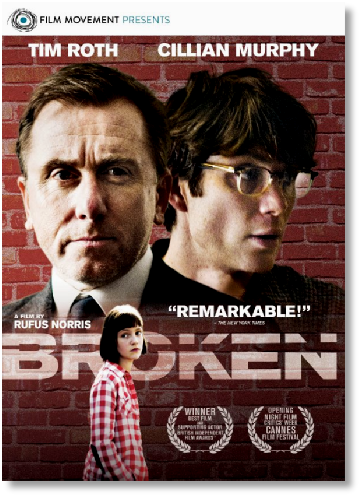
Broken (2013)
Cast
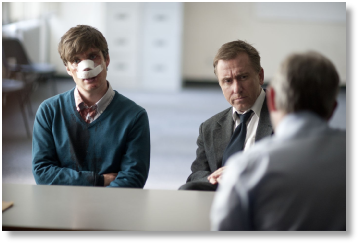
Cillian Murphy as Mike Kiernan
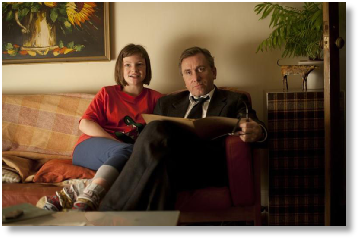
Tim Roth as Archie
Lily James as Older Skunk
Rory Kinnear as Bob Oswald
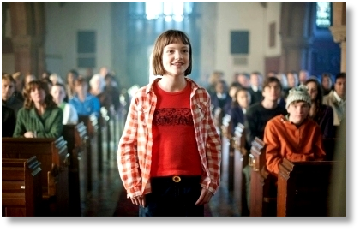
Eloise Laurence as Skunk
Director
Rufus Norris
Novel
Daniel Clay
Screenplay
Mark O'Rowe
Ben Kenigsberg
July 19, 2013
The title "Broken" most directly refers to families, but it's also an adequate assessment
of the Rufus Norris's debut feature, an absorbing coming-
Norris, a West End veteran, edits his film in an oblique, lyrical style that one
associates more with David Gordon Green than with the stage. Events are sometimes
seen slightly out of order, organized for impact rather than chronology. The catalyzing
incident is seen first: As 11-
But back to Skunk: Children are impressionable, and the sight of the attack stays
with her. She worries that Rick will suffer treatment along the lines of what she
saw in "One Flew Over the Cuckoo's Nest." Her own life is in flux, from a bourgeoning
first love to anxiety over being bullied at a new school, where her nanny's commitment-
If it isn't obvious already—from the assonance of Skunk's name with Scout; the way Roth's solicitor is called on to defend the falsely accused; or the way Rick functions as a Boo Radley figure—"Broken" has been quite transparently conceived as an homage to "To Kill a Mockingbird," which author Daniel Clay, who wrote the novel on which the film is based, has acknowledged as an inspiration. At times the movie seems closer to full reworking than tribute, and there's a fascination in seeing a quintessentially American story transplanted to a British context. To the extent that "Broken" follows Harper Lee's template—observing a child's dawning awareness of the morally troubled world around her—it's quite good.
But context is key, and while Lee's masterwork turned an eye on 1930s Alabama, "Broken"
doesn't show much interest in the world beyond the cul-
Rufus Norris on Broken
Theatre director Rufus Norris talks learning the cinematic ropes for his directorial
debut, a coming-
Adapted from Daniel Clay’s acclaimed novel Broken, the debut film by theatre director Rufus Norris has surface similarities with the strain of British social realism typified by the films of Mike Leigh or Ken Loach. Set on a London housing estate, it’s the story of three families whose lives interlock with tragic consequences – their very proximity as neighbours proving explosive.
At its centre is Skunk (played by newcomer Eloise Laurence), an 11-
This child’s eye view on the stormy complexity of the adult world lifts the subject
matter away from the realm of miserablist realism into something much more impressionistic,
Norris’s cinematographer Rob Hardy bathing events with a honeyed, day-
Backed by the BFI Film Fund, Broken won Best Film at the British Independent Film Awards last year – an auspicious start in the film world for Norris. High on Norris’s theatrical CV was an adaptation for the stage of Thomas Vinterberg’s scalding family drama Festen (1998), so it was perhaps inevitable that Norris would one day make the transfer to cinema. But, as he explains, it took some adjusting to get used to working in film: he quickly found that, as director, his authority was rarely challenged.
You’ve come to film with an established reputation from the theatre. Did you find doors opened for you automatically as a result?
I’m sure there’s no set way of making that crossover. I think the reality of it is probably quite fickle. When people are talking about you almost no matter what you’re doing, then people from other areas go “Oh, that’s quite interesting.” Because the critical flavour changes every month, you can be in favour and then out of favour, particularly when you’ve been doing one thing for as long as I’ve been doing theatre. So there’ve been several moments in my career when those doors have appeared to open, then they close again, then they appear to open. It just happened on this occasion that I managed to get my foot in the door.
Rufus Norris
Of course you’ve got to want to do it. I’ve always loved film, but I also think you can scrabble around desperately, working incredibly hard to make something happen, but if you don’t have any support in film that’s very difficult. It’s been made a little bit easier by having a reputation in theatre, so people can relax about one aspect of your skills package. There are things in film that I know nothing about, clearly, but I do know about actors and I do know about story and films usually have something to do with both of those.
What was it that drew you to Broken?
I was very fortunate as I was given the novel before it was even published. My agent
looks after Mark O’Rowe, who did the adaptation. I was told “Have read of this. Mark’s
going to do the adaptation. If you like it, then start putting it together and we’ll
see about persuading the powers-
There are two things that I really responded to about it. One was that there’s somebody
at the centre who is naive, optimistic, a bit oddball, has big eyes – and that’s
kind of a bit like me. So I could stand in her shoes. If I was a 12-
The second thing is that I found the story enabled me to do this with every character. For example, Archie her father – I’m a distracted parent, who overworks and is half good at it some of the time and not at others, like him.
It’s quite a dark film in some ways. It’s got a lot of humour, and it’s uplifting eventually; it’s got a huge, pulsing heart in the middle of it. But there are dark elements to it. I found that even with the characters who behave in the most unsympathetic ways, I could find a way into them, and a way of telling it that would place their own actions in the context of their own feelings.
I’m not the least interested in [showing that] “This person is evil” or “This person is good”. That’s total bullshit: human beings aren’t like that. We’re much more complex. Most of us are capable of doing most things, if circumstances are wrong or right. An ensemble piece where you could explore that with multiple characters was great.
The other [reason] is I’m a theatre director and I don’t know much about film, other
than from the many that I’ve seen. To go into a huge big CGI-
Daniel Clay is very open about the influence of Harper Lee’s To Kill a Mockingbird on his novel. Is that something you were conscious of when making Broken?
It’s interesting because it’s a book that I’ve had a particular love affair with all my adult life, and at one stage was very keen on working on an adaptation of it – many years ago. And it’s one of those rare books where the film matches it. So I was a bit concerned when I read that those were the references.
But I think they’re references [only]. In no way is it an adaptation of that. It’s only at the surface level. It’s like a contemporary, very distant cousin. If somebody didn’t say that and you went to see it, I don’t think it would occur to you. There’s no big courtroom stuff. The moral dilemma that Atticus Finch faces is not at all played out in Broken. There are lots of references and similarities, but I never felt that long shadow. Because it would have been a very long shadow!
It’s a stunning performance from Eloise Laurence as Skunk. How did you find her?
We searched pretty thoroughly for that character. We saw 850 girls altogether, across about a year and a half. And of course you’ve got to get somebody at a particular point in their life. At that stage, she’s about a year away from becoming a woman. There are lots of stories – The Lovely Bones [for example] – where the girl’s on the cusp of womanhood. And the film isn’t about that. This is a child. This is someone who has that naivety; the whole sexual [realm] hasn’t opened up for her yet.
But in terms of casting it, particularly with our very sexualised young culture at the moment, you’ve got to find a particular person who has that genuine innocence. In the end, we got very close to starting on the film and we still hadn’t found her and I was saying, “Sorry guys, we’ve got to keep going, she’s not there yet.” But you worry and think “Have I already met her? Was she this girl? Or that girl?”
But I’ve done a lot of casting and in my experience I get a very clear image of what this person should be like, particularly in this case where I’d storyboarded thousands of pictures and had really defined what she looks like, how she behaves. [Sometimes] someone comes in and completely overturns that – “Fine, that got you to that point but now you’ve got to completely reimagine her because I’m it” – then you know you’ve got a dialogue. Someone’s got to come in and kick all your preconceptions out of the window.
Actually [Eloise is] the daughter of a very good friend of mine who I was working with throughout the whole period! I’d been to an event in the middle of the process, when I was meeting people and I was moaning with another director about not being to find her and she was on the trampoline behind him at the time. So I could have saved myself a bit of time. She turned up at the last minute just through a conversation with this friend of mine.
She’s just got that wonderful thing when somebody just leaves themselves alone and seems oblivious to the camera. She’s not of course; it’s more skilful than that.
In subject matter and location, the film could feel like a social realist film or even a soap opera. But in fact it’s a very beautiful looking, cinematic film.
What sort of instructions did you give your director of photography Rob Hardy?
What sort of notes about acting on screen am I going to give Tim Roth or Cillian Murphy? Rob Hardy’s done a lot of films; I haven’t done any. I chose Rob because I really like his work and it felt like the right pair of eyes for this project. Like you say, it could easily feel like a social realist film except where it goes is too dramatic, and it’s too heightened. You could just think it’s a soap episode that gets out of hand. So it needs a dexterity and a level of magic and beauty in it that allows you to go where the film needs you to go.
So it wasn’t a question of instruction, it was a question of conversation. I’m a collaborator.
You say you’re not interested in presenting heroes and villains, and one of the things
I admire about the film is that the characters who could come across as simply unpleasant
– such as the trouble-
Mark and I talked a lot about that. What is it that mitigates Bob Oswald? How are we not just going to [have to] kill him? Casting is hugely important. Rory Kinnear is an actor who has got enormous emotional access. It’d be very easy to play that character as a thug. There’s one key shot in it where Bob Oswald is ironing his kids’ clothes. He doesn’t say anything, he’s just ironing. That was a pickup shot. We thought we were missing a beat. We’re missing the moment that just has Bob being a dad, being a single dad with three girls. You know, three teenage girls – that’s not easy. With a wife who died three years ago, who we never meet, but we’ve got to feel their loss of her.
This from:
http://www.bfi.org.uk/news-


What the Board( WJEC ) says:
MS4: MEDIA – TEXT, INDUSTRY AND AUDIENCE
This unit focuses on developing both the knowledge students have gained in other areas of the course and their understanding of the links between texts, the industries that have produced them and the different audiences that respond to them.
Key Features
• Centres select three industries to study.
• Centres then select three main texts from each industry to focus on.
Whilst Centres are free to select the texts they consider to be the most suitable for their students to study, contrasting texts are likely to offer students a wider experience and to prepare them more thoroughly for the end of unit exam. Centre selection also needs to take into consideration the fact that:
• Two of the three selected texts per industry must be contemporary (made within the previous five years) In our case “Broken”, “The Hunger Games” (made within the previous five years) and “Little Miss Sunshine (released in 2006
• One text per industry must be British. In our case “Broken”.
For each text selected, candidates should consider the following as appropriate:
Text
genre
narrative
representation
Industry
production
distribution (and exhibition where relevant)
marketing and promotion
regulation issues
global implications
relevant historical background
Audience
audience/user targeting
audience/user positioning
audience responses and user interaction
debates about the relationship between audience/users and text
| Chosen Advertising |
| Chosen film 2014, Broken |
| Chosen Film 2014 The Hunger Games |
| Little Miss Sunshine |
| Textual Analysis |
| magazine front covers |
| gender |
| representation essays |
| varying demographics |